Category: Uncategorized

  • Brain Awareness & Alzheimer’s Disease:  Work to keep your brain healthy and know the signs

    Brain Awareness & Alzheimer’s Disease: Work to keep your brain healthy and know the signs

    By Alzheimer’s Association

    Learn 10 Ways to Love Your Brain

    This June during Alzheimer’s & Brain Awareness Month and you can do your part to help raise awareness of this devastating disease by learning and sharing 10 Ways to Love your Brain.

    Research is still evolving, but evidence is strong that people can reduce their risk of cognitive decline by making key lifestyle changes. Based on this research, the Alzheimer’s Association offers 10 Ways to Love Your Brain, a collection of tips that can reduce the risk of cognitive decline. When possible, combine these habits to achieve maximum benefit for the brain and body:

    1. Break a sweat: Engage in regular cardiovascular exercise that elevates your heart rate and increases blood flow to the brain and body. Several studies have found an association between physical activity and reduced risk of cognitive decline.
    2. Hit the books: Formal education in any stage of life will help reduce your risk of cognitive decline and dementia. For example, take a class at a local college, community center or online.
    3. Butt out: Evidence shows that smoking increases risk of cognitive decline. Quitting smoking can reduce that risk to levels comparable to those who have not smoked.
    4. Follow your heart: Evidence shows that risk factors for cardiovascular disease and stroke – obesity, high blood pressure and diabetes – negatively impact your cognitive health. Take care of your heart, and your brain just might follow.
    5. Heads up: Brain injury can raise risk of cognitive decline and dementia. Wear a seat belt, use a helmet when playing contact sports or riding a bike, and take steps to prevent falls.
    6. Fuel up right: Eat a healthy and balanced diet that is lower in fat and higher in vegetables and fruit to help reduce the risk of cognitive decline. Although research on diet and cognitive function is limited, certain diets, including Mediterranean and Mediterranean-DASH (Dietary Approaches to Stop Hypertension), may contribute to risk reduction.
    7. Catch some ZZZ’s: Not getting enough sleep due to conditions like insomnia or sleep apnea may result in problems with memory and thinking.
    8. Take care of your mental health: Some studies link a history of depression with increased risk of cognitive decline, so seek medical treatment if you have symptoms of depression, anxiety or other mental health concerns. Also, try to manage stress..
    9. Stump yourself: Challenge and activate your mind. Build a piece of furniture. Complete a jigsaw puzzle. Do something artistic. Play games, such as bridge, that make you think strategically. Challenging your mind may have short- and long-term benefits for your brain.
    10. Buddy up: Staying socially engaged may support brain health. Pursue social activities that are meaningful to you. Find ways to be part of your local community – if you love animals, consider volunteering at a local shelter. If you enjoy singing, join a local choir or help at an afterschool program. Or, just share activities with friends and family.

    It’s never too late or too early to start thinking about your brain’s health – making healthy choices at any age is beneficial. Visit  alz.org/10ways   to learn more.

    Know the 10 Signs of Alzheimer’s Disease

    This June during Alzheimer’s & Brain Awareness Month and you can do your part to help raise awareness of this devastating disease by learning and sharing the 10 warning signs of Alzheimer’s disease.

    It may be hard to know the difference between age-related changes and the first signs of Alzheimer’s. Some people may recognize changes in themselves before anyone else notices. Other times, friends and family will be the first to observe changes in memory, behavior or abilities. To help identify problems early, the Alzheimer’s Association has created a list of warning signs for Alzheimer’s and other dementias. Individuals may experience one or more of these in different degrees:

    1. Memory loss that disrupts daily life.
    2. Challenges in planning or solving problems.
    3. Difficulty completing familiar tasks at home, at work or at leisure.
    4. Confusion with time or place.
    5. Trouble understanding visual images and spatial relationships.
    6. New problems with words in speaking or writing.
    7. Misplacing things and losing the ability to retrace steps.
    8. Decreased or poor judgment.
    9. Withdrawal from work or social activities.
    10. Changes in mood and personality.

    If you or someone you care about is experiencing any of these signs, please see a doctor to find the cause. Early diagnosis gives you a chance to seek treatment and plan for your future.

    To learn more about warning signs, visit   alz.org/10signs  or call the Alzheimer’s Association free 24/7 Helpline at 800.272.3900 (TTY:866.403.3073)

    Join the Movement to End Alzheimer’s 

    June is Alzheimer’s & Brain Awareness Month and the Alzheimer’s Association® needs you to get involved and raise awareness about Alzheimer’s disease and other dementias. Everyone who has a brain is at risk to develop Alzheimer’s, a disease that is often misunderstood. Did you know:

    • Alzheimer’s is fatal. It kills more than breast and prostate cancer combined.
    • Alzheimer’s is not normal aging. It’s a progressive brain disease without any cure.
    • Alzheimer’s is more than memory loss. It appears through a variety of signs and symptoms.

    During the month of June, the Alzheimer’s Association asks you to learn more about Alzheimer’s, share your story and take action. Visit alz.org/abam to:

    • Learn and share the facts about Alzheimer’s,.
    • Get inspired by powerful stories of people sharing their experiences with the disease.
    • Go purple — the color of Alzheimer’s awareness — on Facebook, Twitter and more!
    • Honor those facing the disease by participating in the Alzheimer’s Association The Longest Day on June 21. Sign up or donate at alz.org/thelongestday.

    Help the Alzheimer’s Association #ENDALZ this June! Visit alz.org/abam  to get started.

    End of Alzheimer’s Association Article

    Cambrian Senior Living has locations in South Lyon and Tecumseh, Michigan.  Both locations offer specialized services in dementia care.  Support group services are also available on a monthly basis as a free service to the community, so check out our website to learn more at  www.CambrianSeniorLiving.com

  • Caregiver Stress

    Caregiver Stress

    By Alzheimer’s Association

    images copy


    Alzheimer’s caregivers frequently report experiencing high levels of stress. It can be overwhelming to take care of a loved one with Alzheimer’s or other dementia, but too much stress can be harmful to both of you. Read on to learn symptoms and ways to avoid burnout.

    Caregiver Stress Check:  Alzheimer caregivers frequently report high levels of stress. Take the quiz and get resources to help.


    SYMPTOMS OF CAREGIVER STRESS

    • Denial about the disease and its effect on the person who has been diagnosed. I know Mom is going to get better.
    • Anger at the person with Alzheimer’s or frustration that he or she can’t do the things they used to be able to do.   He knows how to get dressed — he’s just being stubborn.
    • Social withdrawal from friends and activities that used to make you feel good.  I don’t care about visiting with the neighbors anymore.
    • Anxiety about the future and facing another day.  What happens when he needs more care than I can provide?
    • Depression that breaks your spirit and affects your ability to cope.  I just don’t care anymore.
    • Exhaustion that makes it nearly impossible to complete necessary daily tasks.  I’m too tired for this.
    • Sleeplessness caused by a never-ending list of concerns.   What if she wanders out of the house or falls and hurts herself?
    • Irritability that leads to moodiness and triggers negative responses and actions. Leave me alone!
    •  Lack of concentration that makes it difficult to perform familiar tasks.  I was so busy, I forgot my appointment.
    • Health problems that begin to take a mental and physical toll.  I can’t remember the last time I felt good.

    If you experience any of these signs of stress on a regular basis, make time to talk to your doctor.  If you are feeling stressed, get support from family, friends and the resources below:
    • Call our 24/7 Helpline: 800.272.3900
    • Locate a support group in your community

    TIPS TO MANAGE STRESS

    If you experience signs of stress on a regular basis, consult your doctor.  Ignoring symptoms can cause your physical and mental health to decline.

    Know what community resources are available. 
Adult day programs, in-home assistance, visiting nurses and meal delivery are just some of the services that can help you manage daily tasks.

    Use our online Community Resource Finder or contact your local Alzheimer’s Association chapter for assistance in finding Alzheimer’s care resources in your community.

    Use Alzheimer’s Navigator, our free online tool that helps evaluate your needs, identify action steps and connect with local programs and services.

    Get help and find support.  Our online Care Team Calendar helps you organize friends and family who want to help provide care and support. Our 24/7 Helpline (800.272.3900), ALZConnected online community and local support groups are all good sources for finding comfort and reassurance. If stress becomes overwhelming, seek professional help.

    Use relaxation techniques.  There are several simple relaxation techniques that can help relieve stress. Try more than one to find which works best for you. Techniques include:   Visualization (mentally picturing a place or situation that is peaceful and calm),   Meditation (which can be as simple as dedicating 15 minutes a day to letting go of all stressful thoughts,  Breathing exercises (slowing your breathing and focusing on taking deep breaths,  Progressive muscle relaxation (tightening and then relaxing each muscle group, starting at one end of your body and working your way to the other end)   Learn more about relaxation techniques on the Mayo Clinic website.

    Sign up for our weekly e-newsletter.  Get ideas for balancing caring for your needs with the needs of a loved one with Alzheimer’s or dementia. Subscribe now.

    Get moving.
  Physical activity — in any form — can help reduce stress and improve overall well-being.  Even 10 minutes of exercise a day can help. Take a walk. Do an activity you love, such as gardening or dancing.

    Find time for yourself. 
Consider taking advantage of respite care so you can spend time doing something you enjoy. Respite care provides caregivers with a temporary rest from caregiving, while the person with Alzheimer’s disease continues to receive care in a safe environment. Learn more about respite care.

    Become an educated caregiver.
As the disease progresses, new caregiving skills may be necessary. The Alzheimer’s Association offers programs to help you better understand and cope with the behaviors and personality changes that often accompany Alzheimer’s. You may also find it helpful to talk to other care partners and caregivers about how they are coping with the challenges of the disease and uncertainty about the future.

    Take care of yourself. 
Visit your doctor regularly. Try to eat well, exercise and get plenty of rest. Making sure that you are healthy can help you be a better caregiver.

    Make legal and financial plans. 
Putting legal and financial plans in place after an Alzheimer’s diagnosis is important so that the person with the disease can participate. Having future plans in place can provide comfort to the entire family. Many documents can be prepared without the help of an attorney. However, if you are unsure about how to complete legal documents or make financial plans, you may want to seek assistance from an attorney specializing in elder law, a financial advisor who is familiar with elder or long-term care planning, or both. Learn more about planning ahead.    (End of Article)

    Cambrian Senior Living is an alternative to assist caregivers when it becomes too much to continue doing so on your own.   Cambrian features specialized memory care services offered in a secure setting designed with the needs of an individual living with dementia in mind.  With locations in both South Lyon and Tecumseh,  Cambrian can assist you with getting back to the things that matter most, keeping a healthy relationship with your loved one.  Also, Cambrian offers support groups on a monthly basis, and the general public is welcome to attend.  For more information call 517-423-5300 for the Tecumseh area and 248-344-0001 for the South Lyon area.

  • The Secret to Living Longer May Be Your Social Life.

    The Secret to Living Longer May Be Your Social Life.

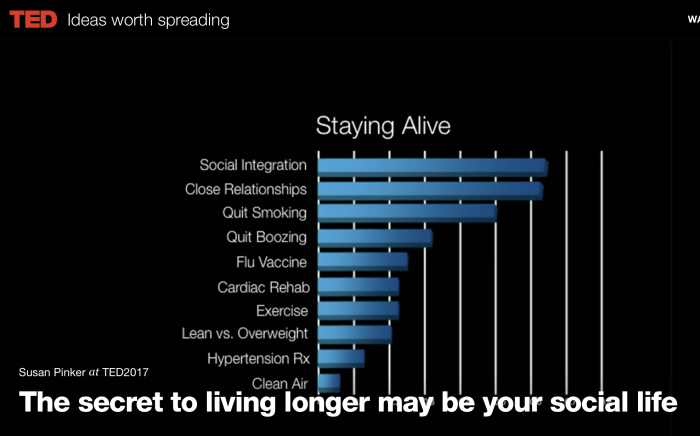
    Susan Pinker Chart Life Expectancy Predictors

    Click Here to Watch the Ted Talk by Susan Pinker (April 2017)

    TRANSCRIPT of TALK:

    Here’s an intriguing fact. In the developed world, everywhere, women live an average of six to eight years longer than men do. Six to eight years longer. That’s, like, a huge gap. In 2015, the “Lancet” published an article showing that men in rich countries are twice as likely to die as women are at any age.

    But there is one place in the world where men live as long as women. It’s a remote, mountainous zone, a blue zone, where super longevity is common to both sexes. This is the blue zone in Sardinia, an Italian island in the Mediterranean, between Corsica and Tunisia, where there are six times as many centenarians as on the Italian mainland, less than 200 miles away. There are 10 times as many centenarians as there are in North America. It’s the only place where men live as long as women.

    But why? My curiosity was piqued. I decided to research the science and the habits of the place, and I started with the genetic profile. I discovered soon enough that genes account for just 25 percent of their longevity. The other 75 percent is lifestyle.

    So what does it take to live to 100 or beyond? What are they doing right? What you’re looking at is an aerial view of Villagrande. It’s a village at the epicenter of the blue zone where I went to investigate this, and as you can see, architectural beauty is not its main virtue, density is: tightly spaced houses, interwoven alleys and streets. It means that the villagers’ lives constantly intersect. And as I walked through the village, I could feel hundreds of pairs of eyes watching me from behind doorways and curtains, from behind shutters. Because like all ancient villages, Villagrande couldn’t have survived without this structure, without its walls, without its cathedral, without its village square, because defense and social cohesion defined its design.

    Urban priorities changed as we moved towards the industrial revolution because infectious disease became the risk of the day. But what about now? Now, social isolation is the public health risk of our time. Now, a third of the population says they have two or fewer people to lean on.

    But let’s go to Villagrande now as a contrast to meet some centenarians.

    Meet Giuseppe Murinu. He’s 102, a supercentenarian and a lifelong resident of the village of Villagrande. He was a gregarious man. He loved to recount stories such as how he lived like a bird from what he could find on the forest floor during not one but two world wars, how he and his wife, who also lived past 100, raised six children in a small, homey kitchen where I interviewed him. Here he is with his sons Angelo and Domenico, both in their 70s and looking after their father, and who were quite frankly very suspicious of me and my daughter who came along with me on this research trip, because the flip side of social cohesion is a wariness of strangers and outsiders. But Giuseppe, he wasn’t suspicious at all. He was a happy-go-lucky guy, very outgoing with a positive outlook. And I wondered: so is that what it takes to live to be 100 or beyond, thinking positively? Actually, no.

    Meet Giovanni Corrias. He’s 101, the grumpiest person I have ever met.

    And he put a lie to the notion that you have to be positive to live a long life. And there is evidence for this. When I asked him why he lived so long, he kind of looked at me under hooded eyelids and he growled, “Nobody has to know my secrets.”

    But despite being a sourpuss, the niece who lived with him and looked after him called him “Il Tesoro,” “my treasure.” And she respected him and loved him, and she told me, when I questioned this obvious loss of her freedom, “You just don’t understand, do you? Looking after this man is a pleasure. It’s a huge privilege for me. This is my heritage.” And indeed, wherever I went to interview these centenarians, I found a kitchen party. Here’s Giovanni with his two nieces, Maria above him and beside him his great-niece Sara, who came when I was there to bring fresh fruits and vegetables. And I quickly discovered by being there that in the blue zone, as people age, and indeed across their lifespans, they’re always surrounded by extended family, by friends, by neighbors, the priest, the barkeeper, the grocer. People are always there or dropping by. They are never left to live solitary lives. This is unlike the rest of the developed world, where as George Burns quipped, “Happiness is having a large, loving, caring family in another city.”

    Now, so far we’ve only met men, long-living men, but I met women too, and here you see Zia Teresa. She, at over 100, taught me how to make the local specialty, which is called culurgiones, which are these large pasta pockets like ravioli about this size, this size, and they’re filled with high-fat ricotta and mint and drenched in tomato sauce. And she showed me how to make just the right crimp so they wouldn’t open, and she makes them with her daughters every Sunday and distributes them by the dozens to neighbors and friends. And that’s when I discovered a low-fat, gluten-free diet is not what it takes to live to 100 in the blue zone.

    Now, these centenarians’ stories along with the science that underpins them prompted me to ask myself some questions too, such as, when am I going to die and how can I put that day off? And as you will see, the answer is not what we expect. Julianne Holt-Lunstad is a researcher at Brigham Young University and she addressed this very question in a series of studies of tens of thousands of middle aged people much like this audience here. And she looked at every aspect of their lifestyle: their diet, their exercise, their marital status, how often they went to the doctor, whether they smoked or drank, etc. She recorded all of this and then she and her colleagues sat tight and waited for seven years to see who would still be breathing. And of the people left standing, what reduced their chances of dying the most? That was her question.

    So let’s now look at her data in summary, going from the least powerful predictor to the strongest. OK? So clean air, which is great, it doesn’t predict how long you will live. Whether you have your hypertension treated is good. Still not a strong predictor. Whether you’re lean or overweight, you can stop feeling guilty about this, because it’s only in third place. How much exercise you get is next, still only a moderate predictor. Whether you’ve had a cardiac event and you’re in rehab and exercising, getting higher now. Whether you’ve had a flu vaccine. Did anybody here know that having a flu vaccine protects you more than doing exercise? Whether you were drinking and quit, or whether you’re a moderate drinker, whether you don’t smoke, or if you did, whether you quit, and getting towards the top predictors are two features of your social life. First, your close relationships. These are the people that you can call on for a loan if you need money suddenly, who will call the doctor if you’re not feeling well or who will take you to the hospital, or who will sit with you if you’re having an existential crisis, if you’re in despair. Those people, that little clutch of people are a strong predictor, if you have them, of how long you’ll live. And then something that surprised me, something that’s called social integration. This means how much you interact with people as you move through your day. How many people do you talk to? And these mean both your weak and your strong bonds, so not just the people you’re really close to, who mean a lot to you, but, like, do you talk to the guy who every day makes you your coffee? Do you talk to the postman? Do you talk to the woman who walks by your house every day with her dog? Do you play bridge or poker, have a book club? Those interactions are one of the strongest predictors of how long you’ll live.

    Now, this leads me to the next question: if we now spend more time online than on any other activity, including sleeping, we’re now up to 11 hours a day, one hour more than last year, by the way, does it make a difference? Why distinguish between interacting in person and interacting via social media? Is it the same thing as being there if you’re in contact constantly with your kids through text, for example? Well, the short answer to the question is no, it’s not the same thing. Face-to-face contact releases a whole cascade of neurotransmitters, and like a vaccine, they protect you now in the present and well into the future. So simply making eye contact with somebody, shaking hands, giving somebody a high-five is enough to release oxytocin, which increases your level of trust and it lowers your cortisol levels. So it lowers your stress. And dopamine is generated, which gives us a little high and it kills pain. It’s like a naturally produced morphine.

    Now, all of this passes under our conscious radar, which is why we conflate online activity with the real thing. But we do have evidence now, fresh evidence, that there is a difference. So let’s look at some of the neuroscience. Elizabeth Redcay, a neuroscientist at the University of Maryland, tried to map the difference between what goes on in our brains when we interact in person versus when we’re watching something that’s static. And what she did was she compared the brain function of two groups of people, those interacting live with her or with one of her research associates in a dynamic conversation, and she compared that to the brain activity of people who were watching her talk about the same subject but in a canned video, like on YouTube. (And by the way, if you want to know how she fit two people in an MRI scanner at the same time, talk to me later.)

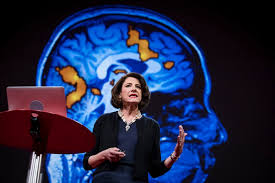
    So what’s the difference? This is your brain on real social interaction. What you’re seeing is the difference in brain activity between interacting in person and taking in static content. In orange, you see the brain areas that are associated with attention, social intelligence — that means anticipating what somebody else is thinking and feeling and planning — and emotional reward. And these areas become much more engaged when we’re interacting with a live partner.

    Now, these richer brain signatures might be why recruiters from Fortune 500 companies evaluating candidates thought that the candidates were smarter when they heard their voices compared to when they just read their pitches in a text, for example, or an email or a letter. Now, our voices and body language convey a rich signal. It shows that we’re thinking, feeling, sentient human beings who are much more than an algorithm. Now, this research by Nicholas Epley at the University of Chicago Business School is quite amazing because it tells us a simple thing. If somebody hears your voice, they think you’re smarter. I mean, that’s quite a simple thing.

    Now, to return to the beginning, why do women live longer than men? And one major reason is that women are more likely to prioritize and groom their face-to-face relationships over their lifespans. Fresh evidence shows that these in-person friendships create a biological force field against disease and decline. And it’s not just true of humans but their primate relations, our primate relations as well. Anthropologist Joan Silk’s work shows that female baboons who have a core of female friends show lower levels of stress via their cortisol levels, they live longer and they have more surviving offspring. At least three stable relationships. That was the magic number. Think about it. I hope you guys have three.

    The power of such face-to-face contact is really why there are the lowest rates of dementia among people who are socially engaged. It’s why women who have breast cancer are four times more likely to survive their disease than loners are. Why men who’ve had a stroke who meet regularly to play poker or to have coffee or to play old-timer’s hockey — I’m Canadian, after all —are better protected by that social contact than they are by medication. Why men who’ve had a stroke who meet regularly — this is something very powerful they can do. This face-to-face contact provides stunning benefits, yet now almost a quarter of the population says they have no one to talk to.

    We can do something about this. Like Sardinian villagers, it’s a biological imperative to know we belong, and not just the women among us. Building in-person interaction into our cities, into our workplaces, into our agendas bolsters the immune system, sends feel-good hormones surging through the bloodstream and brain and helps us live longer. I call this building your village, and building it and sustaining it is a matter of life and death.

    Thank you.

    Susan Pinker is the author of the book The Village Effect: How Face-to-Face Contact Can Make Us Healthier, Happier, and Smarter. Published by Penguin Random House (2015).

    (End of Article)

    With this being said, if you have a parent or loved one living at home alone without a strong social network you should consider seeking a community setting where The Village Effect could benefit.  Cambrian Senior Living has locations  in both South Lyon and Tecumseh, Michigan.  The South Lyon location serves seniors from Lyon Township, New Hudson, South Lyon, Novi, Wixom, Northville, Brighton, and surrounding areas.  The Tecumseh location serves Tecumseh, Onsted, Brooklyn, Britton, Dundee, Adrian, Blissfield, Deerfield, Milan, and surrounding areas.  For more information visit www.CambrianSeniorLiving.com

  • Support for Alzheimer’s & Dementia Caregivers-Cambrian Senior Living Can Help!

    Support for Alzheimer’s & Dementia Caregivers-Cambrian Senior Living Can Help!

    Alzheimer's Walk Mother Daughter

    How to Get the Caregiving Help You Need

    Caring for someone with Alzheimer’s disease or another dementia impacts every aspect of your daily life. As an Alzheimer’s patient loses one ability after another, a caregiver faces tests of stamina, problem solving, and resiliency. Maintaining your emotional and physical fitness is crucial, not just for you but also for the person you’re caring for. Preparing yourself, understanding your loved one’s experience, and seeking support from others can help you succeed on the caregiving journey.
    What is depression?


    The Alzheimer’s care journey

    Caring for someone with Alzheimer’s disease or dementia can be a long, stressful, and intensely emotional journey. But you’re not alone. In the United States, there are about 15 million people caring for someone with dementia, and millions of others around the world. As there is currently no cure for Alzheimer’s disease, and only limited medical treatments available for the symptoms, it is your caregiving that can make the biggest difference to your loved one’s quality of life. That is a remarkable gift.
    However, caregiving can also become all-consuming. As your loved one’s cognitive, physical, and functional abilities diminish over a period of years, it’s easy to become overwhelmed and neglect your own health and well-being. The burden of caregiving can put you at increased risk for significant health problems and an estimated 30 to 40 percent of dementia caregivers will experience depression, high levels of stress, or burnout. Nearly all Alzheimer’s or dementia caregivers will at some time experience sadness, anxiety, loneliness, and exhaustion. Seeking help and support along the way is not a luxury for caregivers; it’s a necessity.
    Just as each individual with Alzheimer’s disease progresses differently, so too can the caregiving experience vary widely from person to person. However, there are strategies that can help make the caregiving journey as rewarding as it is challenging. Learning all you can about what is happening and what to expect on the Alzheimer’s journey will not only help your loved one, but is also the first step towards protecting your own mental and physical health.

    The challenges and rewards of Alzheimer’s care

    Caring for a person with Alzheimer’s disease can often seem to be a series of grief experiences as you watch your loved one’s memories disappear and skills erode. The person with Alzheimer’s will change and behave in different, sometimes disturbing or upsetting ways. For both caretakers and their patients, these changes can produce an emotional wallop of confusion, anger, and sadness.
    As the disease advances, your loved one’s needs will increase and your caregiving responsibilities will become more challenging. At the same time, the ability of your loved one to show appreciation for all your hard work will diminish. Caregiving can literally seem like a thankless task. For many, though, a caregiver’s long journey includes not only challenges, but also many rich, life-affirming rewards.
    Caring for Someone with Alzheimer’s
    Challenges:
    Rewards:
    Overwhelming emotions as capabilities lessen
    Bonds deepen through care, companionship, and service
    Fatigue and exhaustion as caregiving demands increase
    Problem solving and relationship skills grow through experience
    Isolation and loneliness as independence disappears
    New relationships form through education and support
    Financial and work complications as costs rise and resources are challenged
    Unexpected rewards develop through compassion and acceptance.

    Preparing for the Alzheimer’s care experience

    The more you learn about your loved one’s disease and how it will progress over the years, the better you’ll be able to prepare for future challenges, reduce your frustration, and foster reasonable expectations. In the early stages of Alzheimer’s, for example, you can support your loved one’s independence and self-care, but the person’s cognitive and physical regression means he or she will ultimately require 24-hour care.
    Though it may be hard to contemplate such a difficult outlook, the sooner you put plans in place, the more your loved one can be involved in the decision-making process. Paying for long-term care can be a major source of stress, so it’s important to research all your options as early as possible. Consult with the patient’s medical team and other family members to make legal and financial arrangements and determine the long-term care options that are best suited to you and your loved one.

    Planning support for Alzheimer’s caregiving

    Balancing the enormous task of caring for a cognitively-impaired adult with your other responsibilities requires skill, attention, and meticulous planning. By focusing so diligently on your loved one’s needs, it’s easy to fall into the trap of neglecting your own health. But that will not only hurt yourself, but also hurt the person you’re trying to care for. If you’re not getting the physical and emotional support you need, you won’t be able to provide the best level of care, and you face becoming overwhelmed.
    It’s important to plan a support network as early as possible.
    • Ask for help. It’s important to reach out to other family members, friends, or volunteer organizations to help with the daily burden of caregiving. Accepting help for mundane tasks such as grocery shopping and cleaning can free you up to spend more quality time with the patient. When someone offers to help, let them. You’re not being neglectful or disloyal to your loved one. Caregivers who take regular time away not only provide better care, they also find more satisfaction in their caretaking roles.
    • Learn or update caregiving skills. Being thrust into the role of caregiver doesn’t come with an instruction manual, but there are books, workshops, and online training resources that can teach you the skills you need. Learn all you can about symptoms, treatment, and behavior management. As the disease progresses and challenges change, you’ll need to update your skillset and find new ways of coping.
    • Join a support group. You’ll find that you’re not alone and you’ll be able to learn from the experiences of others who have faced the same challenges. Connecting with others who know first-hand what you’re going through can also help reduce feelings of isolation, fear, and hopelessness.
    • Learn how to manage stress. Caregiving for a loved one with dementia can be one of the most stressful tasks you’ll undertake in life. To combat this stress, you need to activate your body’s natural relaxation response through techniques such as deep breathing, meditation, rhythmic exercise, or yoga. Fitting these activities into your life can help reduce the stress of caregiving and boost your mood and energy levels.
    • Make use of available resources. There are a wealth of community and online resources to help you prioritize your efforts and provide effective care. Start by finding the Alzheimer’s association in your country. These organizations offer practical support, helplines, advice, and training for caregivers and their families. They can also put you in touch with local support groups. See Resources and References section below for a directory of associations.
    • Plan for your own care. Visit your doctor for regular checkups and pay attention to the signs and symptoms of excessive stress. It’s easy to abandon the people and activities you love when you’re mired in caregiving, but you risk your health and peace of mind by doing so. Take time away from caregiving to maintain friendships, social contacts, and professional networks, and pursue the hobbies and interests that bring you joy.

    Signs of stress and burnout during Alzheimer’s care

    The stress of day-to-day care, watching your loved one’s health deteriorate, and having to make difficult decisions about long-term care can leave anyone feeling overwhelmed and exhausted. No matter how strong and resilient you are, you’re still likely to have problems with certain aspects of Alzheimer’s or dementia care.
    Recognizing the signs of caregiver stress and burnout is the first step to dealing with the problem.

    10 Signs of Caregiver Stress

    If you experience any of these signs of stress on a regular basis, make time to talk to your doctor.
    1. Denial about the disease and its effect on the person who has been diagnosed. “I know Mom is going to get better.”
    2. Anger at the person with Alzheimer’s, anger that no cure exists, or anger that people don’t understand what’s happening. “If he asks me that one more time I’ll scream!”
    3. Social withdrawal from friends and activities that once brought pleasure. “I don’t care about getting together with the neighbors anymore.”
    4. Anxiety about the future. “What happens when he needs more care than I can provide?”
    5. Depression that begins to break your spirit and affects your ability to cope. “I don’t care anymore.”
    6. Exhaustion that makes it nearly impossible to complete necessary daily tasks. “I’m too tired for this.”
    7. Sleeplessness caused by a never-ending list of concerns. “What if she wanders out of the house or falls and hurts herself?”
    8. Irritability that leads to moodiness and triggers negative responses and actions. “Leave me alone!”
    9. Lack of concentration that makes it difficult to perform familiar tasks. “I was so busy, I forgot we had an appointment.”
    10. Health problems that begin to take a mental and physical toll. “I can’t remember the last time I felt good.”
    Source: Alzheimer’s Association

    Alzheimer’s caregiver burnout

    When prolonged and excessive stress from caring for a loved one with Alzheimer’s or dementia leaves you feeling emotionally, mentally, and physically exhausted, you may be facing burnout. Burnout reduces your productivity and saps your energy, leaving you feeling helpless, hopeless, angry, and resentful. Eventually, you may feel like you have nothing more to give.
    The warning signs of caregiver burnout include:
    • Excessive stress and tension
    • Debilitating depression
    • Persistent anxiety, anger, or guilt
    • Extreme irritability or anger with the dementia patient
    • Decreased overall life satisfaction
    • Relationship conflicts and social isolation
    • Lower immunity and greater need for healthcare services
    • Excessive use of medications, drugs, or alcohol
    Burnout can damage your health and the health of the person you’re caring for, so if you recognize the signs, it’s important to take action right away.

    Coping with stress and burnout during Alzheimer’s care

    No matter the day-to-day demands of caregiving for a patient with Alzheimer’s or dementia, it’s imperative that you carve out time for your own self-care. These tips can help:
    • Seek regular respite care. You cannot do it all alone. Ask other family members, friends, or members of your place of worship for help with respite care so you can get a much needed break. You can also seek help from volunteer organizations, support groups, day care programs, and residential respite care facilities. Schedule frequent breaks throughout the day, take time out to pursue hobbies and interests, and stay on top of your own health needs. Seek professional help if you recognize you’re exhibiting any warning signs of caregiver burnout.
    • Get moving.  Regular exercise not only keeps you fit, it releases endorphins that can really boost your mood. Aim for at least 30 minutes of exercise on most days. If it’s difficult to get away for that long at once, break the time up into 10 minute sessions sprinkled throughout the day. Take a walk or jog outside, dance to your favorite music, work out to an exercise DVD, or cycle to the store. Taking a group exercise class or working out with friends can give you a much needed social outlet as well.
    • Talk it over. Talk to a trusted friend, family member, clergy member, or therapist, about how you feel and what you’re going through. The person you talk to doesn’t have to be able to solve your problems, he or she just has to be a good listener. The simple act of talking face-to-face with someone who cares can be extremely cathartic. Opening up won’t make you a burden to others. In fact, most friends will be flattered that you trust them enough to confide in them, and it will only strengthen your bond.
    • Take time to play. In the early stages of Alzheimer’s disease, include your loved one in short walks, board games, or jigsaw puzzles. Join an online scrabble tournament, practice your golf swing, or play with a pet. A daily dose of fun is good medicine, and doesn’t require money, a car, or huge blocks of time.
    • Try something new. Challenge yourself to learn a new skill while you are “on the job.” Order a self-paced foreign language program or try an exercise video game. From tennis to golf to pitching a strike, so-called “exergames” offer living room-friendly activities for every age and skill level. With just a few minutes of practice each day, you can flex mental muscle and relieve harmful stress.
    • See the funny side. Humor is a well-known antidote to stress, sadness, illness, and boredom. Give yourself permission to chuckle at the absurdities you and your loved one experience, and surround yourself with laughter. Instead of heavy dramas on TV or video, go for a hearty belly laugh by watching episodes of your favorite sitcom. Your infectious good mood can help replenish your inner resources and sooth your loved one.

    Making time for reflection during Alzheimer’s care

    One of the biggest challenges as a caretaker for someone with Alzheimer’s or dementia is to accept what is happening to your loved one. At each new stage of the disease, you have to alter your expectations about what your loved one is capable of. By accepting each new reality and taking time to reflect on these changes, you can better cope with the emotional loss, and deepen the feelings of satisfaction and love in your role as caretaker.
    • Keep a daily journal to record and reflect on your experiences. By journaling your thoughts, you can mourn losses, celebrate successes, and look for those thought patterns that keep you from acting in the present.
    • Count your blessings. A daily gratitude list can chase away the blues and let you focus on what your loved one is still capable of, rather than the abilities he or she has lost.
    • Celebrate what is possible. Your loved one still has many abilities. Structure activities to invite participation on whatever level is possible, and you will both find real enjoyment.
    • Try to envision your loved one’s world. Imagine not being able to remember and do life’s simple tasks. By valuing what your loved one is able to give, you can find satisfaction on even the toughest days.
    • Practice relaxation techniques. Meditation, deep breathing, visualization, mindfulness, yoga, or rhythmic exercise can calm, restore, and promote happiness. Experiment with different techniques to find the ones that work best for you.
    • Improve emotional awareness. Remaining engaged, focused, and calm in the midst of such tremendous responsibility can challenge even the most capable caregivers. By developing your emotional awareness skills, however, you can relieve stress, experience positive emotions, and bring new peace and clarity to your caretaking role.

    Make time to really connect.  Even when the person you’re caring for can no longer verbally express love or appreciation, you can find a deeper sense of reward in your role as caregiver by making time each day to really connect with the person. Avoid all distractions and focus fully on the person. Make eye contact (if that’s possible), hold the person’s hand or stroke his or her cheek, and talk in a calm, reassuring tone of voice. When you connect in this way, you’ll experience a process that boosts your mood, reduces stress, and supports your physical and emotional well-being. And it can also have the same effect on your loved one.

    How to help an Alzheimer’s or dementia caregiver

    If a friend or family member is caring for someone with Alzheimer’s or dementia, it’s important to offer all the help and support you can.
    • Don’t wait to be asked to help. Many caregivers find it difficult to ask others for help, no matter how much they may need it, so make the offer. And when you do, be specific. As well as simply asking, “What can I do to help?” make suggestions like, “I’m free tomorrow afternoon, can I sit with the patient while you take a break?” or “What can I get you from the grocery store today?” Helping out with even the most simple or mundane chores can free the caregiver up to spend more quality time with the patient or take a break to recharge his or her batteries.
    • Be a friend. Caregivers are prone to withdrawing from family and friends but they still need regular contact with the outside world. Phone calls, texts, or emails are fine, but nothing beats a personal visit to lift a caregiver’s mood. Again, don’t wait to be asked; be the one to reach out.
    • Be a good listener. Venting frustrations about caregiving can be a great stress reliever. Listen to the caregiver’s fears and concerns without judging.
    • Show your gratitude. If the caregiver is a sibling looking after your parent, for example, it’s important to express your gratitude. The person with mid- or late-stage Alzheimer’s or dementia may not able to show appreciation to the caretaker so it’s important other family members recognize the caregiver’s hard work and sacrifice and regularly show their appreciation. While a card or a simple “Thank you” can go a long way, when accompanied by the offer of some respite, it can be a blessing.
    • Recognize the signs of caregiver stress and encourage the caregiver to focus more on his or her own health and well-being.

    Where can I find help?

    Cambrian Senior Living has locations in Michigan; Tecumseh & South Lyon. Cambrian serves the surrounding areas as well, such as Britton, Onsted, Adrian, Manchester, Brooklyn, Saline, Chelsea, Lyon Township, New Hudson, Milford, Wixom, Farmington Hills, Northville, Plymouth, and Livonia. Cambrian offers a support group on a monthly basis to assist caregivers with the struggles that come along with caring for someone with Alzheimer’s and the many other forms of dementia. To see when the next support group is scheduled, visit www.cambrianseniorliving.com/support-groups/.

    As published on HelpGuide.org.

mauslot link alternatif